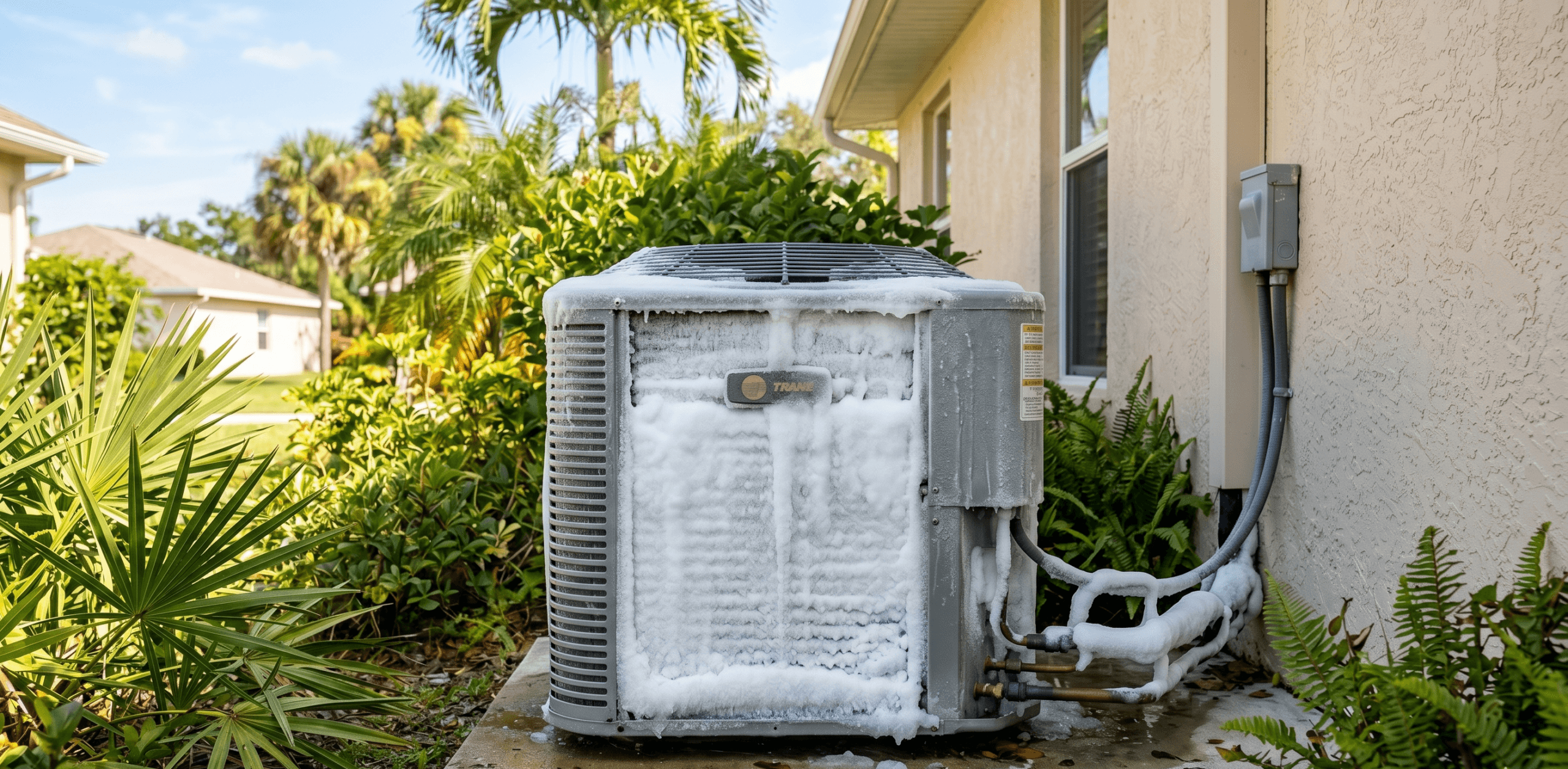
Why is my air conditioner freezing up during the summer?
Your AC freezes when there is insufficient warm airflow passing over the indoor evaporator coil, or when the system is critically low on refrigerant. Without enough heat to absorb, the coil’s temperature drops below freezing, instantly turning the surrounding Florida humidity into solid ice. The most common culprits are clogged air filters, blocked air vents, a failing blower motor, or a microscopic refrigerant leak.
It can be confusing for Sarasota homeowners to see their air conditioner’s copper pipes and indoor coils encased in ice, even when it is 92 degrees outside.
Below is a technical explanation for “why is there ice on my AC?” and the steps you should take to prevent permanent damage.
The Science of a Frozen AC
To understand ice formation, it is important to know how an air conditioner works. Your AC does not create cold air; it removes heat.
The indoor evaporator coil contains cold, pressurized refrigerant. As the blower motor moves warm air over the coil, the refrigerant absorbs heat and moisture. If airflow stops or refrigerant pressure drops, the coil becomes too cold, causing moisture to freeze on the metal.
A thin layer of ice further restricts airflow, leading to a cycle that can encase the entire unit in ice.
Culprit #1: The “Suffocating” System
In 80% of frozen AC cases, the primary issue is a lack of airflow. When the system cannot circulate air, it freezes.
- Clogged Filter: During spring pollen season, air filters can become blocked within weeks. If air cannot pass through the filter, it will not reach the coil.
- Closed Vents: Closing vents in unused rooms may seem cost-effective, but it increases static pressure and reduces the warm air needed for proper system function.
- Failing Blower Motor: If the blower motor is malfunctioning or covered in dust, it cannot move enough air to keep the coil above freezing.
Culprit #2: The Silent Refrigerant Leak
Air conditioning systems are closed loops and do not use up refrigerant. If your system is low on Freon, Puron, or R-32, there is a leak.
When refrigerant levels decrease, pressure inside the evaporator coil also drops. This lowers the coil temperature below 32°F, freezing condensation. A professional must locate and seal the leak, then recharge the system to factory specifications.
What to Do Immediately if Your AC is Frozen
If you see ice on the copper lines or notice warm air from the vents, turn off the system immediately.
1. Turn the Thermostat to “OFF”
Running the cooling cycle with ice present can damage the compressor, which is the most expensive component to replace.
2. Turn the Fan to “ON”
Set the fan from “Auto” to “On” to circulate warm air over the frozen coil and speed up thawing.
3. Check the Filter
Remove the air filter. If it is covered in dust, replace it.
4. Wait 24 Hours
The system must be fully thawed before a technician can test refrigerant pressures or inspect for leaks.
Get Professional AC Help
If the system freezes again after thawing and replacing the filter, a mechanical issue requires professional attention.
For 40 years, D&D Air has diagnosed, repaired, and replaced AC systems on Florida’s West Coast. Our technicians will identify the root cause of freezing, whether it is an airflow restriction or a hidden leak, and provide an honest, transparent assessment.
Do not let a frozen coil damage your compressor. Call D&D Air at (941) 297-0089 to schedule a comprehensive diagnostic and restore comfort to your home.